
Bodies and Belonging on this Transgender Day of Visibility
Today is International Transgender Day of Visibility
I am thinking about the liberation transgender people can symbolize for the rest of the Church.
In the Western World, we have been shaped to mistrust and dislike our bodies. When I was growing up, we only had to worry about comparing ourselves to photoshopped images. Today, because of A.I., we can’t even be sure that many of the images we see are based in reality at all. From the media we consume, the products we buy, and the weight loss systems we cycle through, our bodies are trained to be ever present sources of scrutiny, insecurity, and shame.
It’s not simply malicious; it’s capitalist. Globally, the beauty industry is worth $500 billion and the health and wellness industry is worth about $5 trillion. In America, the weight loss industry does $70 billion in business each year, and the healthcare industry, whose predominant methodology is curing disease (treatment) rather than promoting wellness (prevention), costs $4.5 trillion annually, or about 17% U.S. GDP.
In the Western World, we have been shaped to mistrust and dislike our bodies. When I was growing up, we only had to worry about comparing ourselves to photoshopped images. Today, because of A.I., we can’t even be sure that many of the images we see are based in reality at all. From the media we consume, the products we buy, and the weight loss systems we cycle through, our bodies are trained to be ever present sources of scrutiny, insecurity, and shame.
It’s not simply malicious; it’s capitalist. Globally, the beauty industry is worth $500 billion and the health and wellness industry is worth about $5 trillion. In America, the weight loss industry does $70 billion in business each year, and the healthcare industry, whose predominant methodology is curing disease (treatment) rather than promoting wellness (prevention), costs $4.5 trillion annually, or about 17% U.S. GDP.

An entire economic system depends on us believing that our bodies are problems to solve. That we are too much or not enough. Too soft, too large, too small, too old, too different. And if we just buy the right product, follow the right routine, optimize ourselves in the right way, then we will finally be acceptable.
But it’s not just capitalism. Even in the Gospels, we see how deeply this instinct runs.
In John 9, Jesus’ disciples encounter a man who was born blind, and their first question is revealing: “Rabbi, who sinned, this man or his parents, that he was born blind?”
They see a body that does not fit their expectations, and they assume something must have gone wrong, but Jesus refuses the premise.
But it’s not just capitalism. Even in the Gospels, we see how deeply this instinct runs.
In John 9, Jesus’ disciples encounter a man who was born blind, and their first question is revealing: “Rabbi, who sinned, this man or his parents, that he was born blind?”
They see a body that does not fit their expectations, and they assume something must have gone wrong, but Jesus refuses the premise.
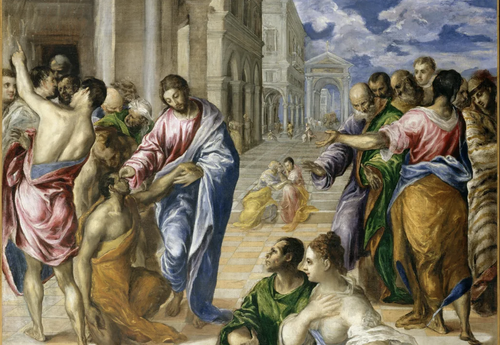
Many modern scholars, including voices in disability theology, have pointed out that Jesus’ response is often mistranslated in ways that reinforce the very logic he is rejecting. The traditional reading makes it sound like the man’s blindness exists so that God can show off through healing. But that misses the point. A better reading and a more accurate translation emphasized by scholars like Allison Barr, goes something like this: “Neither this man nor his parents sinned. But let the works of God be revealed in him.”
It’s not about what’s wrong. It’s about what God is doing right here, in this person, just as they are.
Disability theologians have been telling the church this for a long time. There is nothing wrong with disabled bodies in the way we often presume. They are not broken versions of some ideal human form. They are not problems waiting to be fixed or objects of pity. They are fully human, fully worthy, fully held in the life of God.
Jesus agrees.
And that matters a great deal because the instinct to label bodies as “wrong” doesn’t stop with disability. We do it all the time. We do it whenever someone’s body doesn’t fit the categories and the gender binaries we’ve been taught to trust. And for many of us, encountering someone who is at home in a body that challenges those categories—especially trans bodies—can feel deeply unsettling. Not because something is wrong with them, but because something is being revealed in us: assumptions, fears, and the cultural conditioning we’ve inherited about what bodies are supposed to be.
Which brings me to another story.
It’s not about what’s wrong. It’s about what God is doing right here, in this person, just as they are.
Disability theologians have been telling the church this for a long time. There is nothing wrong with disabled bodies in the way we often presume. They are not broken versions of some ideal human form. They are not problems waiting to be fixed or objects of pity. They are fully human, fully worthy, fully held in the life of God.
Jesus agrees.
And that matters a great deal because the instinct to label bodies as “wrong” doesn’t stop with disability. We do it all the time. We do it whenever someone’s body doesn’t fit the categories and the gender binaries we’ve been taught to trust. And for many of us, encountering someone who is at home in a body that challenges those categories—especially trans bodies—can feel deeply unsettling. Not because something is wrong with them, but because something is being revealed in us: assumptions, fears, and the cultural conditioning we’ve inherited about what bodies are supposed to be.
Which brings me to another story.
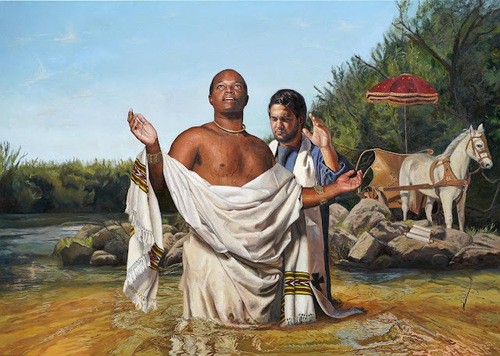
In Acts 8:26–39, an Ethiopian eunuch is traveling home after making a pilgrimage to Jerusalem. What made this African, whose body defies the binary, want to come to the Temple in Jerusalem in the first place? Did they know that they would be turned away upon arrival?
Acts doesn’t give us the details, but Deuteronomy 23:1 tells us that eunuchs are forbidden to enter the temple. Sexual minorities keep out.
Here we read of a person who has traveled a long distance, spiritually and physically, only to encounter a boundary. Presumably, they must now turn around and head home. But as they go, the text says they read the scroll of the Prophet Isaiah (53:7-8).
I don’t think I would continue reading your sacred texts, if you turned me away, but this eunuch, and most of the trans Christians I know, are more faithful than I am.
As the eunuch reads and travels, God sends Philip to them. The eunuch tried to approach God and was barred, but God won’t be barred from reaching the eunuch. Through Philip, the Good News of Jesus is shared.
Then the eunuch asks the question at the center of the story: “What is to prevent me from being baptized?” It’s the same question that sits at the center of many human lives: What prevents me from belonging? from being fully included? from being received as I am?
And the answer is beautifully simple: Nothing.
Philip baptizes the eunuch right there, on the side of the road. No gatekeeping. No temple. No institution standing in the way. Just water and welcome.
Despite what you’ve been told— despite the exclusion you’ve experienced—you are welcome and wanted in the Kingdom of God.
Acts doesn’t give us the details, but Deuteronomy 23:1 tells us that eunuchs are forbidden to enter the temple. Sexual minorities keep out.
Here we read of a person who has traveled a long distance, spiritually and physically, only to encounter a boundary. Presumably, they must now turn around and head home. But as they go, the text says they read the scroll of the Prophet Isaiah (53:7-8).
I don’t think I would continue reading your sacred texts, if you turned me away, but this eunuch, and most of the trans Christians I know, are more faithful than I am.
As the eunuch reads and travels, God sends Philip to them. The eunuch tried to approach God and was barred, but God won’t be barred from reaching the eunuch. Through Philip, the Good News of Jesus is shared.
Then the eunuch asks the question at the center of the story: “What is to prevent me from being baptized?” It’s the same question that sits at the center of many human lives: What prevents me from belonging? from being fully included? from being received as I am?
And the answer is beautifully simple: Nothing.
Philip baptizes the eunuch right there, on the side of the road. No gatekeeping. No temple. No institution standing in the way. Just water and welcome.
Despite what you’ve been told— despite the exclusion you’ve experienced—you are welcome and wanted in the Kingdom of God.
On this Trans Day of Visibility, I want to say as clearly as I can: The Church needs visible trans people as witnesses to a kind of honesty and courage that many of us are still learning. Because when someone is at home in their own body—especially in a world that has told us not to be—it reveals how much our relationship to our bodies has been shaped by fear, pressure, and systems that profit from our dissatisfaction.
It reveals how often we have confused conformity with faithfulness, and it invites us into something deeper. Not a world where every question is resolved or where every category is clear, but a world where people are seen and welcomed.
I find great comfort in the idea that the eunuch got back in their chariot after being baptized and continued reading Isaiah. If they read just three more chapters, they would encounter one of the most inclusive and boundary breaking passages in all the Old Testament.
For this is what the Lord says:
“To the eunuchs who keep my Sabbaths,
who choose what pleases me
and hold fast to my covenant—
to them I will give within my temple and its walls
a memorial and a name
better than sons and daughters;
I will give them an everlasting name
that will endure forever. (Isaiah 56:4-5)
Within the same Bible we find verses to bind and verses to liberate. Within the same story, we see religion used to exclude a sexual minority from worship, and we also see the Way of Jesus used as a force for inclusion and empowerment.
And that tension hasn’t gone anywhere. We still live in a world that teaches us to distrust our bodies. We inherited systems that decide who belongs and who doesn’t. We still ask the wrong questions about what’s “wrong” with people instead of paying attention to what God is doing in them.
But the good news is God keeps showing up on the road. Not inside the systems that exclude. Not behind the walls that keep people out. But out in the wild where the people are. All of the people.
On this Trans Day of Visibility, I want to say this clearly: Your existence is not a problem to be solved. In a world that pressures you to disappear, your visibility is not just courage— your existence is resistance. And maybe, in time, the rest of us might learn from your example how to live more honestly, more freely, and more faithfully in our own bodies.
It reveals how often we have confused conformity with faithfulness, and it invites us into something deeper. Not a world where every question is resolved or where every category is clear, but a world where people are seen and welcomed.
I find great comfort in the idea that the eunuch got back in their chariot after being baptized and continued reading Isaiah. If they read just three more chapters, they would encounter one of the most inclusive and boundary breaking passages in all the Old Testament.
For this is what the Lord says:
“To the eunuchs who keep my Sabbaths,
who choose what pleases me
and hold fast to my covenant—
to them I will give within my temple and its walls
a memorial and a name
better than sons and daughters;
I will give them an everlasting name
that will endure forever. (Isaiah 56:4-5)
Within the same Bible we find verses to bind and verses to liberate. Within the same story, we see religion used to exclude a sexual minority from worship, and we also see the Way of Jesus used as a force for inclusion and empowerment.
And that tension hasn’t gone anywhere. We still live in a world that teaches us to distrust our bodies. We inherited systems that decide who belongs and who doesn’t. We still ask the wrong questions about what’s “wrong” with people instead of paying attention to what God is doing in them.
But the good news is God keeps showing up on the road. Not inside the systems that exclude. Not behind the walls that keep people out. But out in the wild where the people are. All of the people.
On this Trans Day of Visibility, I want to say this clearly: Your existence is not a problem to be solved. In a world that pressures you to disappear, your visibility is not just courage— your existence is resistance. And maybe, in time, the rest of us might learn from your example how to live more honestly, more freely, and more faithfully in our own bodies.